The write way to say goodbye: a biographer’s story
- by Maria Lopez
- June 2, 2026
SHARE


Guest blog written by Emma Rossi, Volunteer Manager, Sacred Heart Biography Service.
A couple of years ago I traded in my career in corporate communications for that of a biographer of the dying.
Based at St Vincent’s Hospital Sydney, my role is to record patients’ stories so their legacy lives on past their death. It’s an opportunity for those with little time left on this earth to explore the value of their life.
I’ve learnt a lot in the past months as I’ve sat with many patients in the palliative care ward.
Often people think palliative care is about shortening life or stopping normal medical treatment or that it’s only for the last days before someone dies. But none of those things is true.
Palliative care is about comfort and dignity. For my father, Theo, after a massive stroke, it was about the family being around him, ensuring he was in no pain. Nor would he be resuscitated.
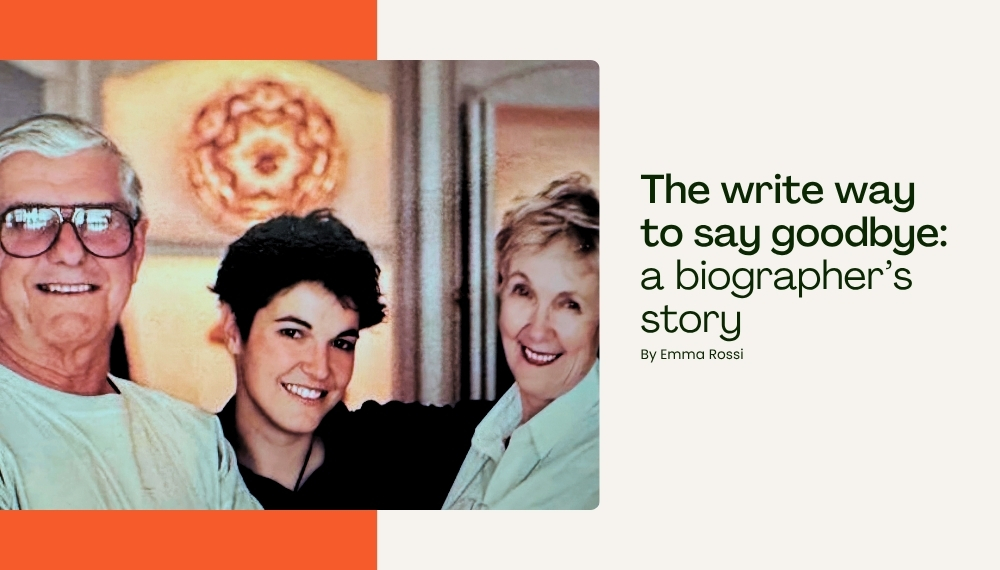
For my mother, Mary Rossi, who had a big career as a TV presenter and in travel, palliative care meant five months of living at home, with instructions no ambulance was to take her to hospital. There were carers, but there was also laughter, crosswords, egg sandwiches and ice cream, and visits from family and friends.
It gave us time to plan and say goodbye. We read Mum her funeral booklet. She suggested more music and less talking.
Central to palliative care is listening. Listening is an art. To listen we subvert our ego, our desire to interrupt, and we pay attention.
Listening is an act of kindness that’s not just about our ears but our eyes and our heart. To really listen, we’re present to the suffering of others and hold the space.
Sometimes we struggle to know what to say when someone says they’ve got only a limited time to live. I’ve learnt the best thing is to try avoiding saying too much. Being there, available, with compassionate presence is often enough.
Like the young mother, Claire, with a very young daughter. Claire told me she was dying of cancer. I offered, “I can only imagine how hard this must be …”
I’ve come to understand that in palliative care my colleagues are champion individuals who daily place themselves in the frontline of death and dying, situations most of us try to avoid.
For the dying, telling their story can be cathartic.
A growing number of health-care institutions now offers biography services where these life stories are captured. The process involves sitting with the dying and letting them talk.
Biographers have the privilege of being a witness to people exploring the value of their life. When first referred to palliative care, our patients and their families are often overwhelmed, confused and wrestling with their dark night.
One dying woman, Angie, in her early 40s, is not afraid of death because she is donating her body to research. She has a greater purpose. She’s excited her body will be used to train the next generation of doctors.
The biographies can be as short as a one-page letter to grandchildren, a passing on of wisdom. Many patients have a story they need to tell, even if they don’t want it included in their printed biography. We do not curate the story but lightly edit it so the narrative flows.
In telling their stories our patients realise they are so much more than their illness or what’s happening to them medically.
In telling their stories our patients realise they are so much more than their illness or what’s happening to them medically … They can still love and be loved
They can get in touch with the essence of who they were before their role and identity changed. They are still creative, they still have a sense of humour, they still enjoy reading or listening to historical podcasts. They can still love and be loved.
We’ve heard the story of an elderly gentleman, Bob, living in a rental and who has little or no teeth. Bob loves his family and has children from three partners. Bob has only recently connected with one of the adult children. He wants to leave a legacy, something to be known and remembered by. Biography does that.
Biography is a win, win, win. As well as the patient benefits, and the legacy document for families, our biographers report learning so much from patients about life. There is something about sharing life with others that makes us feel more human, connected.
The process of telling our story to a biographer trained in unconditional positive regard has an impact. Our patients and their families report their loved one has more self-esteem, feels less lonely and their anxiety may reduce. They’re often so invested in the biography process that they dress up and might put on a tie, ready to greet the biographer with photos, warmth and good humour.
In a care community, the totality of our learning is how important it is to have the conversation about end-of-life care. There are wonderful tools and resources, and extraordinary people in Australia who place patients at the heart of everything they do.
Emma Rossi is biography services manager at St Vincent’s Hospital. Mary Rossi was a well-known TV presenter, a leading travel agent and a mother of 10 who died in 2021 at the age of 95.
—
This article was originally published in The Australian and reproduced with permission.
SHARE
Upcoming Events
- OCTOBER 20 - OCTOBER 21, 2026
- 9:00 AM - 5:00 PM
2026 Volunteer Managers Conference
Held just once every two years, the NSW Palliative Care Vol...
Read more
- DECEMBER 1, 2026
- 10:00 AM - 12:00 PM
NSW Network of Managers of Palliative Care Volunteers – December meeting & Christmas lunch
The role of the Network is to ensure best practice for managers of palliati...
Read moreBecome a member of Palliative Care NSW
Palliative Care New South Wales is the peak body in NSW representing palliative care providers and those with an interest in palliative care. Palliative Care New South Wales is a member of the national peak body Palliative Care Australia.
Join today and receive discounts, benefits and more!
Special member rate available for volunteers.
Subscribe to our eNews
Be the first to know our latest new, events, and research!
SUBSCRIBE TO ENEWS