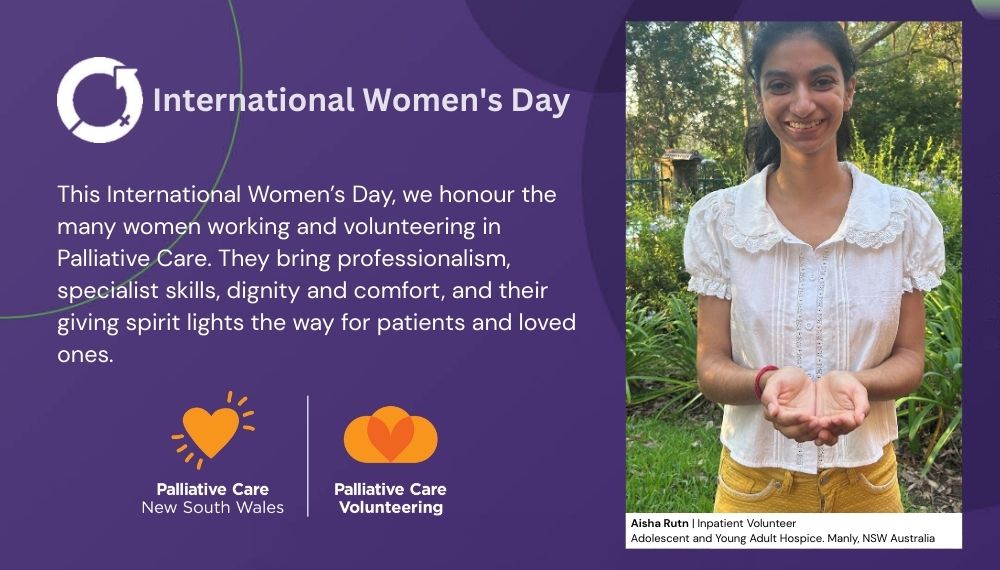
International Women’s Day 2026: Aisha’s Journey
- by Maria Lopez
- March 6, 2026
SHARE


For Aisha, volunteering in palliative care has been a time of powerful personal growth and meaning making. As one of the inpatient volunteers at the Adolescent and Young Adult Hospice in Manly she regularly provides social support and companionship to patients and their families.
We love spreading the word about palliative care volunteering so asked Aisha if she would be kind enough to answer some questions about her experiences for us to share.
What first drew you to the idea of volunteering in palliative care?
Prior to volunteering in palliative care, I had been experiencing some dissatisfaction with parts of my life – my achievements and who I was becoming. At times, I didn’t fully appreciate myself and the life I had, and moments of genuine joy or passion were fewer and further between.
However, from a young age, I have felt compelled to give to others, to love and to serve. Whilst selfish, I felt that through service, I could develop as a person and grow closer to the person I wanted to be – through practicing and living my values. I came to learn this is also how I could acknowledge my strengths, find value in myself, develop value for my life and develop an idea of what success could look like for me – with my skills, abilities and passions.
I hadn’t yet found a means of serving with purpose, in an environment where I felt I was giving meaningfully, working collaboratively and effectively with others. Volunteering at the Adolescent and Young Adult Hospice met all these needs and exceeded them. Interacting with palliative care staff and allied health professionals who shared these values enabled me to give meaningfully.
Retrospectively, volunteering at this facility has taught me a lot about finding meaning and value in life. Specifically, the magic of life is found in the immaterial. It’s found in another’s smile, an act of service, kindness and connection. The experience taught me about the power of healthy mindsets and of embracing each moment as it comes and accepting and feeling every emotion in its fullest. Ultimately, the experience allowed me to develop in terms of my mental and emotional health.
What did you understand palliative care to be about before you started, and how has that understanding changed?
Truthfully, I didn’t know too much about palliative care before I started. Today I know exponentially more.
Patients at the Adolescent and Young Adult Hospice visit for a few days, weeks or months at a time. They can visit for respite, symptom management or end of life support.
Regardless of the reason they visit, they are entitled to meaningful connection, presence from the person they are connecting with and opportunities for fun, joy and laughter. If they experience sadness, anger or frustration or any of the emotions in between, honouring their agency is the most important thing.
Can you share a particularly memorable moment with a patient or their family that has stayed with you?
On a particularly difficult day for me, I was due to prepare for a presentation with the hospice’s volunteer coordinator. Before that meeting, I had lunch with one of the patients. I noticed he seemed less cheerful than he had been in the previous weeks. His plate was placed at the head of the table, and a staff member mentioned that a nurse would be coming to assist him. His voice was softer than usual, and he appeared to have less energy. “I don’t need help,” he said quietly, though the comment went unheard.
I reflected on these experiences and how the patient may have felt – possibly that others doubted him, and several minutes later, feeling ignored and overlooked. To further add to these heavy emotions, his illness was complex and there was rapid progression and loss of skills he used to have.
When I was upstairs with the patient, he said he was bored. I tried to pick up the energy and said, “then we have to do something!” and I asked what he’d like to do. He responded excitedly with the word “art!!!”. We shared a smile. I thought it would be fun to turn shaving cream different colours with paint and mix all the colours up. I sat opposite him at the art table and drew an upside-down smiley face with shaving cream and squeezed out some paint for each part on top. I felt his energy lighten and his body language soften. I handed him a paintbrush and then asked if he’d like to put his hands in. He first replied no and then yes. He looked at me and asked, “what about you?”, to which I thought – fair point, because I didn’t have any excuse not to.
After a bit of mixing, there was no more white shaving cream. And then only brown shaving cream. When we were finished and had to wash our hands, I helped him out of the room forgetting about my hand full of brown shaving cream and left a dripping mess on the floor. The patient’s reaction was to say, “Oh my God”, teasing me for making a mess.
When he asked to paint on a canvas, I began putting the other materials away and setting up the next activity. He teased me for being slow, though he said it with a smile and without complaint.
I didn’t expect my bad day to significantly and overwhelmingly improve simply from spending time with a patient and doing some art activities. Likewise, I didn’t expect the patient’s mood to also improve, given the experiences in the earlier part of the day. He put potentially very heavy and distressing feelings and experiences aside and seemed to really enjoy the afternoon by being present in the moment. I believe this is the true meaning of resilience.
This volunteering experience taught me so much about the power of connection, presence, genuine care, smiles, and joy. In picking up the energy for the patient, and providing him an opportunity for joy, he returned joy to me, and we continued to lift each other up. The joy multiplied. We both benefited. I believe every connection (if time and context are right) is an opportunity for joy.
Has anything surprised you about being a palliative care volunteer?
Emotions aren’t straightforward. They are complex.
Emotions like grief depend on the day, time, person, context and situation. Sometimes grief looks like strength, composure and presence. Sometimes, it looks like frustration, anger or sadness. Sometimes, patients and families enjoy connecting with others and sometimes they don’t. Sometimes, that connection is about being in silence with others, and sometimes it’s about talking with others.
As a volunteer, you are likely to see snippets of all these emotions being in the presence of many different patients and families at different times.
I have found that being present with the person (if and when they would like company), through attending to their verbal and non-verbal cues and being with them to develop a relationship is something that generally supports the individual.
What qualities do you think are most important for a palliative care volunteer to have?
Love – to be and act with love. It is embodied; thus, it is a noun. It is an act; thus, it is a verb. It is a way of doing an act; and thus, it is an adjective. It allows me, and likely the other – to feel lighter, warmer, gentler, happy and healthy. I aim to practice the value of love through serving. More practically, this role taught me about what love means in the context of volunteering in palliative care; it means being curious, present, listening, and being kind and compassionate.
In loving, you are doing the most appropriate, kind and ethical thing for the patient, context and time – given the skills, knowledge and resources you have.
Courage – to have good emotional awareness and stability to acknowledge when and where this quality can be effectively exuded in palliative care volunteering is important. I love Brene Brown’s definitions… to be brave when you can’t control the outcome, to sit in the darkness when things are uncomfortable, to sit in the light with others when things are wonderful. There are many uncomfortable spaces, places, conversations and emotions as a palliative care volunteer. Equally, there are many wonderful, joyful and fun spaces, places, conversations and emotions. Embracing all these and not shying away from them is courage.
Joy – to truly marvel and explore the depth and breadth of this wonderful emotion, to invite it when it is appropriate, to sit in it with presence and enjoy it with others is something I think is important in my volunteer position.
If you could describe the experience of being a palliative care volunteer in one word, what would it be and why?
Transformative. You will build capacity and confidence in areas that you may not have had the opportunity to before. Through spending time with a diverse range of patients with diverse abilities, interests and with diverse demographics and backgrounds, you learn lots about patients, staff and yourself. Through being curious and interested to learn, personally, I was learned more.
You learn lots about yourself in particular… maybe subconscious assumptions and biases, maybe emotions, thoughts, or ideas that you are comfortable or uncomfortable experiencing or exploring. Again, in being curious, I learned more about myself and others.
If you’re inspired by Aisha’s journey and feel called to make a meaningful difference, we invite you to consider becoming a palliative care volunteer. Your presence can transform lives, including your own. For more information about palliative care volunteering in NSW please click here.
SHARE
Upcoming Events
- OCTOBER 20 - OCTOBER 21, 2026
- 9:00 AM - 5:00 PM
2026 Volunteer Managers Conference
Held just once every two years, the NSW Palliative Care Vol...
Read more
- DECEMBER 1, 2026
- 10:00 AM - 12:00 PM
NSW Network of Managers of Palliative Care Volunteers – December meeting & Christmas lunch
The role of the Network is to ensure best practice for managers of palliati...
Read moreBecome a member of Palliative Care NSW
Palliative Care New South Wales is the peak body in NSW representing palliative care providers and those with an interest in palliative care. Palliative Care New South Wales is a member of the national peak body Palliative Care Australia.
Join today and receive discounts, benefits and more!
Special member rate available for volunteers.
Subscribe to our eNews
Be the first to know our latest new, events, and research!
SUBSCRIBE TO ENEWS