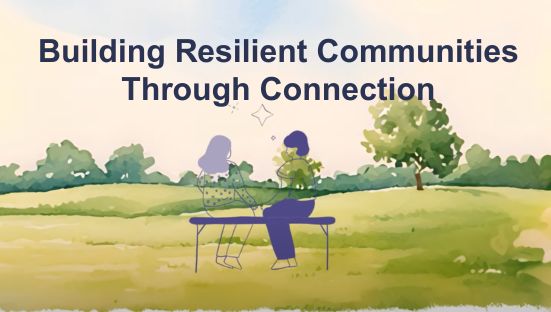
Building resilient communities through connection
- by Kate Bowman
- June 19, 2026
SHARE


In this International Year of the Volunteer, it is worth noting volunteers do more than just support people with declining health. They are an important link with communities, boosting well-being and a collective sense of belonging.
Taking on a similar role to palliative care volunteers in Australia, Canada has Nav-CARE volunteers. They spend time with people in declining health and their families providing companionship and resources. The Canadian Hospice Palliative Care Association recently posted this story in ehospice about building resilient communities through connection.
What makes a community resilient? While infrastructure and services are important, the real flex lies in relationships. Communities become stronger when people know and look out for one another and feel they belong.
Volunteers help people endure challenges, recover from setbacks, and remain connected to their home and social circles. Whether they’re reaching out to someone who’s feeling isolated, swapping stories over coffee, supporting a community-based organisation, or simply showing up consistently for someone who needs extra help, volunteers build communities where people feel seen, valued, and supported. When everyone’s individual capacity grows from that support, the collective is stronger.
For many volunteers, that work begins with a deeply personal understanding of what it means to care for others.
One volunteer recalls regularly driving from her home near Stonewall to visit her mother in Steinbach. Every two weeks, she would spend the day with her, helping fill what she describes as ‘some of the void in her life.’
“We really connected, and had so much fun together,” she remembered.
When her mother passed away, the volunteer found herself missing her sense of purpose.
“Now it’s kind of like I have no one to care for,” she said. Volunteering through Nav-CARE helped fill that void while allowing her to support others who might otherwise be facing loneliness on their own.
Her story reflects an important truth about resilience: communities thrive when people recognize needs and step in to meet them. Volunteers are uniquely positioned to notice both the gaps and the possibilities and create opportunities for connection. Through regular visits and conversations, they help folks feel less isolated and more engaged with the world around them. In many cases, those conversations become pathways to other relationships and sources of support.
Bill, a volunteer from Stonewall, Manitoba, believes this ripple effect extends well beyond the individuals receiving support. As people become more aware of one another’s experiences, they’re better equipped to respond collectively to challenges. A stronger sense of connection builds a sturdier foundation for resilience.
Volunteers also help preserve and share knowledge within their communities. Through listening, they create space for stories, experiences, and wisdom that might otherwise go unheard.
“Even when someone’s further along in their dementia journey and their stories might be a little bit hard to follow,” Bill explains, “there are still threads. And in those threads, there’s such wisdom and gems that are so nice to witness.” Those conversations are meaningful not only for the people sharing their stories, but also for the listening volunteers.
“Listening to stories helps me reflect on my own journey and my own family,” Bill says. “Things I might want to do differently, new perspectives I get to learn.”
Sierra, a pharmacy student and volunteer in Southern Manitoba, has found similar lessons through her work. She recalls how the preceptors in her program encouraged her to become curious about the whole person, rather than focusing solely on medications or medical conditions. That perspective stayed with her and continues to shape how she approaches relationships with others. These exchanges of knowledge, perspective, and lived experience help people better understand one another. They remind us that everyone has something to contribute.
Volunteers also foster belonging, particularly for people experiencing social isolation. While loneliness is often invisible, its effects can be profound. One volunteer remembers helping a client wrap Christmas presents while excitedly preparing for a family visit. The gifts were carefully placed beneath the tree in anticipation. When she returned after the holidays, the presents were still there. The family had been unable to visit due to illness.
“It literally broke my heart,” she says. “I didn’t realize how much isolation can really affect someone.” At first, building a relationship with her client was difficult. Conversations felt one-sided and trust was slow to develop. But over time, something changed.
“The more I showed up and came, we really developed a trust in the relationship.”
That simple act of continuing to show up can be transformative. Volunteers help people feel included, welcomed, and valued. In doing so, they strengthen one of the most important ingredients of community resilience: a sense of belonging.
Perhaps most importantly, volunteers remind people that they do not have to face life’s challenges alone.
Whether someone is coping with illness, grief, loneliness, caregiving responsibilities, or another difficult circumstance, the knowledge that another person is willing to listen and help can make an enormous difference. Recovery and resilience rarely happen in isolation. They emerge through relationships and through communities that create spaces of mutual support.
Some volunteers describe this work not as something they do, but as a way of being in the world. Their motivation comes from the simple belief that helping others matters. In a time when many people are searching for ways to strengthen their communities, volunteers offer a powerful example. Through compassion, curiosity, and consistency, they help build the relationships that allow communities to adapt, recover, and thrive.
Resilient communities are not built all at once. They are built conversation by conversation, visit by visit, and relationship by relationship, with volunteers leading the way.
Read the original article here in ehospice.
SHARE
Upcoming Events
- OCTOBER 20 - OCTOBER 21, 2026
- 9:00 AM - 5:00 PM
2026 Volunteer Managers Conference
Held just once every two years, the NSW Palliative Care Vol...
Read more
- DECEMBER 1, 2026
- 10:00 AM - 12:00 PM
NSW Network of Managers of Palliative Care Volunteers – December meeting & Christmas lunch
The role of the Network is to ensure best practice for managers of palliati...
Read moreBecome a member of Palliative Care NSW
Palliative Care New South Wales is the peak body in NSW representing palliative care providers and those with an interest in palliative care. Palliative Care New South Wales is a member of the national peak body Palliative Care Australia.
Join today and receive discounts, benefits and more!
Special member rate available for volunteers.
Subscribe to our eNews
Be the first to know our latest new, events, and research!
SUBSCRIBE TO ENEWS